Arrange a coffee corner around the sequence you repeat: store, measure, grind, brew and clean up. Leave room to lift lids and move a wet brewer. A good-looking station becomes frustrating when every cup starts with moving decorative objects.
Rehearse one ordinary morning
Before adding a tray, shelf or matching jars, make your usual coffee and notice what you reach for. Where do the beans start? Where does the kettle get filled? Where can you set a dripper while you carry a cup away? These are better starting points than filling every space in a reference image.
Try laying down paper rectangles for the tools you intend to buy. Then open the cupboards and trace the movement from the water source to the brewing area. A kettle that fits on the counter may still be awkward if its lid hits a shelf.
Choose one brewing method before choosing accessories
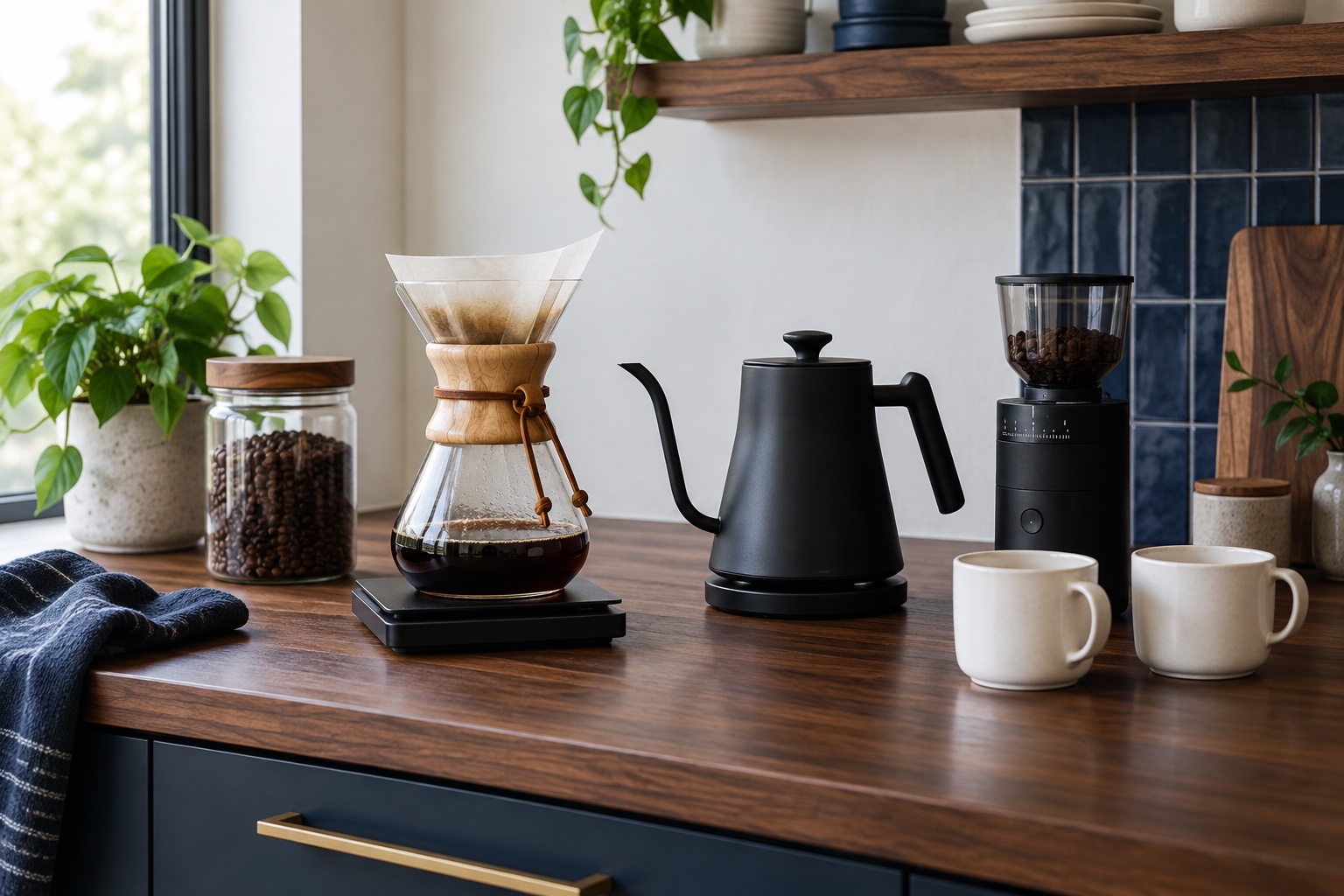
Our Slow Morning look is a filter-coffee starting point. It is not an espresso station, and a filter grinder should not be assumed to suit every espresso machine. Choose the coffee you want to make, then check that the brewer, filters and grinder suit that method.
The National Coffee Association’s brewing library explains drip, pour-over, espresso and other methods separately. Use its method guides if you are still deciding what you enjoy. Matching the equipment to your routine is more useful than buying a collection of unrelated tools.
Make this personal: compare a plan against your budget and start with the pieces you need.
Spend on a missing function, not a matching finish
The full Slow Morning plan allows $400, including a $150 grinder allowance and $100 for a kettle. If both existing tools already suit your brewing method, removing those two lines leaves $150 in the plan. This is catalog budget arithmetic, not a retailer price or a savings promise.
Keep a canister only if it solves storage in your routine. Four matching mugs may suit a shared kitchen, but someone who already has favorite cups can remove that pack too. The useful question is what prevents you from making coffee comfortably today.
- Check lid clearance as well as counter width and depth.
- Match filters to the exact brewer.
- Check electrical and clearance instructions for the selected appliances.
- Leave a washable area for drips and used brewing tools.
| Moment | What to check | Possible buying decision |
|---|---|---|
| Preparing | Can you reach beans and measure without moving decor? | Keep storage close; skip unnecessary display pieces. |
| Brewing | Can the lid open and the cup sit securely? | Measure usable space before selecting equipment. |
| Cleaning | Where will the wet brewer and used filter go? | Reserve a clear work area before buying another accessory. |
A QUICK PLANNING CHECK
Is your coffee corner ready for a real morning?
A kettle fits under a shelf when closed. What still needs checking?
Turn the idea into your own plan
Explore the Slow Morning shopping list, remove what you own and review each product’s specifications. The full list has a $400 USD planning allowance before your changes.
As an Amazon Associate I earn from qualifying purchases. These are independent budget allowances, not current retailer prices or promised savings. Check the exact listing, variant, quantity and delivery estimate before buying.
Keep planning
Sources & further reading
- National Coffee Association: brewing methods — Method-specific starting points for choosing brewing equipment.